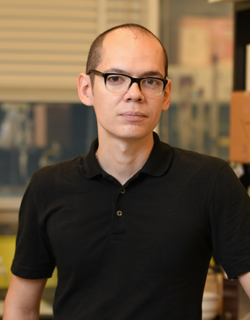
Sebastian Duno-Miranda, Postdoctoral Researcher at Stanford University, California, USA

CBE=Centro de Biologia Estructural, CBB=Centro de Bioquimica y Biofisica. From right to left: Sebastian Duno (CBE), Ruth García (CBE), Gustavo Márquez (CBE), Pura Bolaños (CBB) , Antonio Pinto (CBE), Lorenzo Alamo (CBE) and Raúl Padrón (CBE). June 2018
Taken in year 2019, at the beginning of my Ph.D. (probably now taken down from the UVM website)

(Left to right) Sebastian Duno-Miranda, Roger Craig, Raúl Padrón, Thomas Irving and Weikang Ma, co-authors of an X-ray study of live tarantula muscles, at the Advanced Photon Source in November 2019. (Image courtesy of Thomas Irving, IIT.)

Taken in year 2023, in the Biophysical Society 2023 Meeting, San Diego, U.S.A.

Right after my dissertation defense (August 2025) (Left to right) David Warshaw (advisor), Sebastian Duno-Miranda, Raúl Padrón (advisor emeritus)
My academic journey began at the Central University of Venezuela (UCV), where I cultivated a childhood interest in the intricate mechanisms of life.
My PhD work intersected biology and artificial intelligence (AI) by
1) studying the mechanics of cardiac myosin, a tiny molecular motor that lives inside our hearts and powers the beating of our hearts.
2) applying machine learning to get 100X faster answers from cardiac myosin motility data, as well as enabling scientists to ask real-time motility questions.
For those not familiar with the in vitro motility assay, please see Huxley, H. E. (1990). Sliding filaments and molecular motile systems. The Journal of biological chemistry, 265(15), 8347-8350 for a classical review.
Motility data provided and continues to provide instrumental support during the development of small molecule drugs against diseases of the heart such as Hypertrophic Cardiomyopathy. Critically, these are heart failure diseases that had NO direct, non-invasive treatment, and were only treated palliative until the FDA approval of both CAMZYOS (mavacamten, MYOKARDIA-Brystol-Myers) and MYQORZO (aficamten, CYTOKINETICS). In the close future we should be hearing about additional small molecule drugs from EDGEWISE, BRAVEHEART BIO, and other newcomers.
After my PhD, I joined the Spudich Lab at Stanford University, where I am combining in silico and in vitro methods to understand elusive aspects of cardiac myosin function that might hold the key to understanding how to design next generation cardiac myosin inhibitors and activators, for which a huge unmet need remains.
Below you will find a list of my publications.
Last update: 9/17/25.
Duno-Miranda.org
@Seb_dm
American Heart Association Pre-Doctoral Fellow 2023-2024
About Me
I started my training as a biologist at the Universidad Central de Venezuela (UCV) and the Instituto Venezolano de Investigaciones Cientificas (IVIC). My Licentiate thesis degree advisor was Dr. Raúl Padrón, whom which I studied the structure and function of tarantula muscle, a key non-conventional animal model to understand muscle function in humans.
Next, I would move to pursue doctoral studies at the University of Vermont, under Dr. David M. Warshaw supervision, studying the molecular mechanics of human cardiac myosin, the motor responsible for powering up the contractions of the human heart, the effect of multiple cardiomyopathy mutations, and the application of machine learning to enhance myosin single-molecule data analysis.
Now, I’ve joined the lab of Dr. James Spudich at Stanford University, to continue pushing the frontiers of knowledge regarding the molecular physiology of human myosins in the context of heart disease.
Open source software
A simple and fast image annotator for image machine learning tasks
Idea about Optimization of an Up-scalable Graph Neural Network based on the C. Elegans Connectome Nervous System
Table of Contents Format-er (must have for students and writers creating tables of contents in Word)
Publications
Refereed Journal Papers in chronological order
(1) Padrón R, Ma W, Duno-Miranda S, Koubassova N, Lee KH, Pinto A, Alamo L, Bolaños P, Tsaturyan A, Irving T, Craig R. The myosin interacting-heads motif present in live tarantula muscle explains tetanic and posttetanic phosphorylation mechanisms. Proc Natl Acad Sci U S A. 2020 Jun 2;117(22):11865-11874. doi: 10.1073/pnas.1921312117. Epub 2020 May 22. PMID: 32444484; PMCID: PMC7275770.
(2) Ma W, Duno-Miranda S, Irving T, Craig R, Padrón R. Relaxed tarantula skeletal muscle has two ATP energy-saving mechanisms. J Gen Physiol. 2021 Mar 1;153(3):e202012780. doi: 10.1085/jgp.202012780. PMID: 33480967; PMCID: PMC7822627.
(3) Duno-Miranda S, Nelson SR, Rasicci DV, Bodt SML, Cirilo JA Jr, Vang D, Sivaramakrishnan S, Yengo CM, Warshaw DM. Tail length and E525K dilated cardiomyopathy mutant alter human β-cardiac myosin super-relaxed state. J Gen Physiol. 2024 Jun 3;156(6):e202313522. doi: 10.1085/jgp.202313522. Epub 2024 May 6. PMID: 38709176; PMCID: PMC11074782.
(4) Duno-Miranda S, Warshaw DM, Nelson SR. Automated Tracking of Learned Actin Structures (ATLAS) in the Motility Assay. Biophys Rep (N Y). 2025 Jun 21:100221. doi: 10.1016/j.bpr.2025.100221. Epub ahead of print. PMID: 40550418.
Conference Abstracts in chronological order
1) Duno-Miranda, S., Pinto, A., Alamo, L., Bolaños, P. & Padrón, R. Cooperative phosphorylation activation mechanism explains force potentiation and post-tetanic potentiation on intact tarantula skeletal muscle. II X-Ray Crystallography in Structural Biology Workshop. Centro Latinoamericano de Formación Interdisciplinaria (CELFI). Universidad de Buenos Aires. Argentina. 2018.
2) Duno-Miranda, S., Pinto, A., Alamo, L., Bolaños, P. & Padrón, R.. Cooperative phosphorylation activation mechanism explains force potentiation and post-tetanic potentiation on intact tarantula skeletal muscle.16th Alpbach Workshop on Molecular Motors. Alpbach, Austria. 2019.
3) Duno-Miranda, S., Nelson, S. R., Rasicci, D., Bodt, S. M., Vang, D., Sivaramakrishnan, S., … & Warshaw, D. M. (2023). Molecular mechanics of E525K dilated cardiomyopathy mutant human cardiac myosin. Biophysical journal, 122(3), 406a.
4) Duno-Miranda, Sebastian, David M. Warshaw, and Shane R. Nelson. “Machine learning-enhanced real-time & high-throughput tracking for the in vitro motility assay.” Biophysical Journal 123.3 (2024): 277a.
5) Ge, Jinghua, et al. “Cardiomyopathy-associated mutations in the converter domain of beta-cardiac myosin differentially alter formation of the super relaxed state and interacting heads motif.” Biophysical Journal 123.3 (2024): 317a.
6) Debrunner, Ianna S., et al. “Using synthetic thick filaments made from DNA to model the regulation of β-cardiac myosin motility by cMyBP-C.” Biophysical Journal 123.3 (2024): 124a.
7) Duno-Miranda, Sebastian, David M. Warshaw, and Shane R. Nelson. “BPS2025-Automated tracking of actin learned structures (ATLAS) in the motility assay.” Biophysical Journal 124.3 (2025): 46a.
8) Ge, Jinghua, et al. “BPS2025-Differential modulation of beta-cardiac myosin conformations by cardiomyopathy-associated mutations in the converter domain.” Biophysical Journal 124.3 (2025): 615a.
Biology Licentiate dissertation:
Duno-Miranda, S. Estudio del mecanismo de activación por fosforilación cooperativa de la contracción de músculo de tarántula.
Licentiate Diss. 2018. http://saber.ucv.ve/handle/10872/19595
Refereed Journal covers
1) Journal of General Physiology, June 3rd, 2024
More resources
Contact
Sebastian Duno-Miranda, PhD
X/formerly Twitter: @Seb_dm
Linkedin: www.linkedin.com/in/dunomiranda/
Biochemistry department
Stanford University
Palo Alto, CA